The final amount also depends on the Catastro’s reference value, professional fees, whether the purchase is financed, and the cost of converting funds into euros. This guide provides a worked budget and then compares the main Costa de la Luz towns for buyers considering the Cádiz coast.
Everything here was verified against Spanish primary sources on August 14, 2026. Dollar figures are rounded at about US$1.15 per euro (ECB reference rate, August 2026).
How are resales and new builds taxed in Andalusia?
Spanish purchase tax depends on the type of property and the autonomous community in which it is located.
A resale pays the region’s transfer tax, ITP at a flat 7% since April 2021. Reduced rates of 6% and 3.5% exist for certain primary-home buyers, including some younger buyers, people with disabilities and large families. A typical second-home buyer will not qualify.
A new build from a developer pays instead national VAT at 10% plus Andalusia’s 1.2% stamp duty on the deed: 11.2% combined, versus 7%.
On €300,000, that is €33,600 for a new build compared with €21,000 for a resale, a difference of €12,600 before professional fees. The higher tax burden on a new build should be included when comparing it with a similarly priced resale.
ITP and AJD are regional taxes, so these figures apply to Andalusia rather than Spain as a whole. Other autonomous communities set their own rates.
Can the taxable value be higher than the agreed price?
Since 2022, the Catastro publishes a reference value (valor de referencia) for each property, built from actual notarized sale prices, and it operates as the minimum taxable base for ITP and AJD. Declare a price above it and you’re taxed on your price. Agree a genuine bargain below it and you’re taxed on the reference value anyway.
Look up the reference value before signing. It may raise the taxable base above the agreed price, and a significant difference between the two values deserves an explanation.
Do not confuse it with the separate valor catastral, which is used for annual municipal property tax, known as IBI. The two official values serve different purposes.
How much should you allow for notary, registry, and legal fees?
Notary and registry fees are set by national tariff, not negotiation, and the tariff arithmetic on €300,000 produces surprisingly small base figures: roughly €388 (about US$450) notary and €205 (about US$240) registry after the tariffs’ own discounts.
Actual invoices can be higher once copies, folios, and per-entry charges are included. Market guidance places notary and registry bills around 0.1% to 0.5% and 0.1% to 0.3% respectively. These are planning ranges rather than quotes.
Beyond the tariffs, allow for a gestoría at a market rate of about €400 (about US$460), unless your lawyer handles the filings. An independent lawyer may charge around 1% to 1.5%, or €3,000 to €4,500 on this example, although fixed fees are also common.
The legal work is explained in Spain buying pitfalls. Include it in the purchase budget from the outset.
Which mortgage closing costs does the lender pay?
Since Real Decreto-ley 17/2018, the lender pays the stamp duty on the mortgage deed. Since Ley 5/2019, the lender also pays the loan deed’s notary, registry, and gestoría costs.
The borrower’s only mandatory new closing cost is the property valuation by a Bank-of-Spain-homologated firm, a market €300 to 700 (about US$350 to 800).
These rules substantially reduce the borrower’s mortgage-deed costs. The lender’s arrangement fee, valuation, interest rate, insurance conditions, and other product terms still affect the total cost of borrowing and should be compared separately.
Do not use a pre-2019 mortgage-cost estimate for a current purchase. Ask the lender for the standardized mortgage information sheet required under EU rules and an itemized statement of the costs that remain yours.
How much can currency conversion add to the purchase?
Currency conversion can become a material cost because part of the charge may appear in the exchange rate rather than as a separate fee.
Market comparisons put a retail bank’s exchange-rate margin at about 2% to 4%, compared with 0.3% to 0.7% through specialist currency brokers. On a €300,000 transfer, that is roughly €6,000 to 12,000 (about US$6,900 to 13,800) versus €900 to 2,100 (about US$1,000 to 2,400).
These are order-of-magnitude illustrations based on commercial comparisons, not guaranteed quotes. Compare the all-in amount of euros received, including fees and the exchange-rate margin, before arranging a large transfer.
What does a €300,000 purchase cost in total?
Everything above, assembled for the same €300,000 purchase:
| Resale (cash) | New build | |
|---|---|---|
| Purchase tax | €21,000 property transfer tax (US$24,200) | €30,000 VAT + €3,600 stamp duty (US$38,600) |
| Notary, registry, gestoría, lawyer | ≈€4,000–5,500 | ≈€4,000–5,500 |
| Total above asking price | ≈€25,000–26,500 (US$28,700–30,500), 8.3–8.8% | ≈€37,600–39,100 (US$43,200–45,000), 12.5–13.0% |
Financed variant: add the €300–700 valuation and essentially nothing else on your side.
Every figure is an illustration using general Andalusian rates. The notary’s calculation, the property’s reference value, and your lawyer’s quote will determine the actual total.
Which annual costs continue after completion?
IBI, the municipal property tax, runs on the cadastral value inside a legal band of 0.4 to 1.10% set by each town hall. On a hypothetical €130,000 (about US$150,000) cadastral value, that’s €520 to 1,430 (about US$600 to 1,600) a year. We quote no specific town’s current rate, because those live in each ayuntamiento’s annual ordinance; your IBI receipt or town hall gives the real one.
Community fees, where applicable, are the building’s own budget: market guidance spans roughly €600 to 4,800 (about US$700 to 5,500) a year from a modest flat to an amenity-heavy urbanización.
Non-resident imputed-income tax (IRNR) can apply even when the owner uses the property personally and receives no rent. It taxes a notional income calculated from the cadastral value at 19% for EU/EEA residents and 24% for others. On our hypothetical value, that produces €624 (about US$720) a year at the general 2% base for a US owner and €494 (about US$570) for an EU owner.
The reduced 1.1% base was extended by decree only through tax year 2025. Its application for 2026 was not confirmed as of August 14, 2026, so the table uses the 2% default. The 1.1% case would produce €286 for a US owner and €227 for an EU owner on the same hypothetical value. Confirm the applicable base when filing.
How do Cádiz, Conil, Barbate, Zahara, and Tarifa compare?
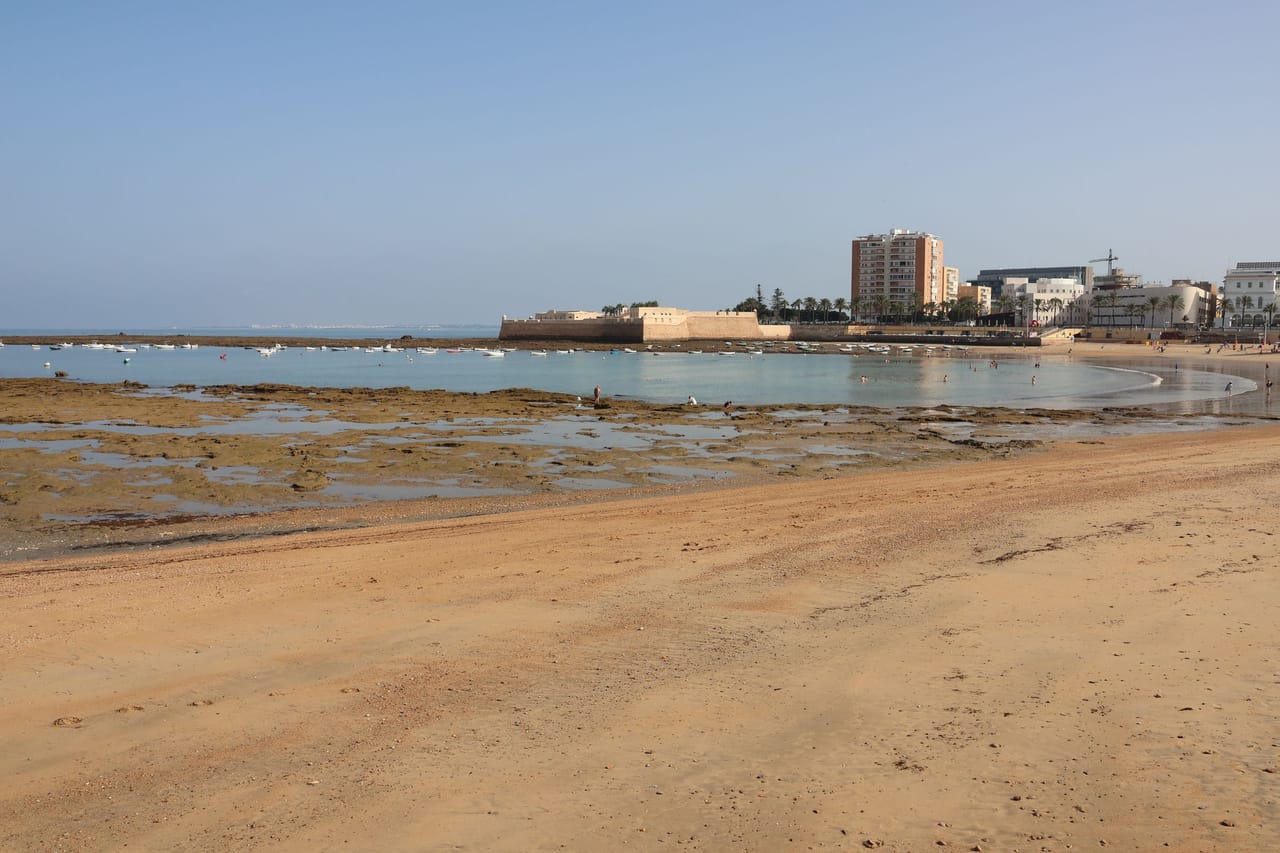
The Costa de la Luz in Cádiz province has a different climate and rhythm from Spain’s Mediterranean resorts. The comparison below focuses on place and lifestyle rather than unsupported town-level prices or yields.
The comparison uses 2025 population figures from Andalusia’s statistics institute, August 2026 air-access information for Jerez, Seville, and Gibraltar, and the Junta’s wind data. The levante can reach 120 km/h and is reported on roughly 150 days a year, making wind a practical part of the location decision, especially near Tarifa.
| Place | Scale | Character and practical fit |
|---|---|---|
| Cádiz (110,123) | Provincial capital | One of Western Europe’s oldest cities; urban apartments, full services, the least “resort” of the five |
| Conil de la Frontera (24,133) | Beach town | The most conventionally resort-like: 13+ km of beaches, summer population multiples, classic second-home product |
| Barbate (22,686) | Working coastal town | Almadraba tuna port diversifying into tourism; nature-adjacent (La Breña park, Cabo Trafalgar); authenticity over polish |
| Zahara de los Atunes (~1,400 permanent) | Resort village within Barbate | Small, low-density, and highly seasonal; a distinct beach identity with the thinnest year-round market of the five |
| Tarifa (18,627) | Wind-sport capital | The levante made it Europe’s kite/windsurf hub; younger, international, activity-driven; the region’s clearest lifestyle niche |
The character descriptions are editorial assessments based on population, access, and climate. Any observations about rental demand or liquidity are inferences rather than measured town-level statistics.
All five locations share Andalusia’s purchase-tax regime, but they offer different levels of year-round activity, services, exposure to wind, and seasonality. Choose the town for the way you expect to use the property, then apply the same cost framework to the specific home.
Our Cádiz coast destination guide covers the area and the developments from builders that have passed our review there. DSH is an education and referral platform; your lawyer and gestor turn this article’s ranges into your actual numbers.
Disclaimer
Dream Second Home is not a tax advisory or a law firm, and this article is not tax or legal advice. It is an educational summary verified on August 14, 2026 against the cited primary sources. Market estimates, including legal help, administrative services, community fees, currency conversion and total notary costs, are labeled as estimates. The reduced 1.1% base used to calculate non-resident imputed-income tax was not confirmed for 2026, so the article does not assume that it applies. Your Spanish lawyer and administrative adviser should turn these ranges into actual figures before you commit.