
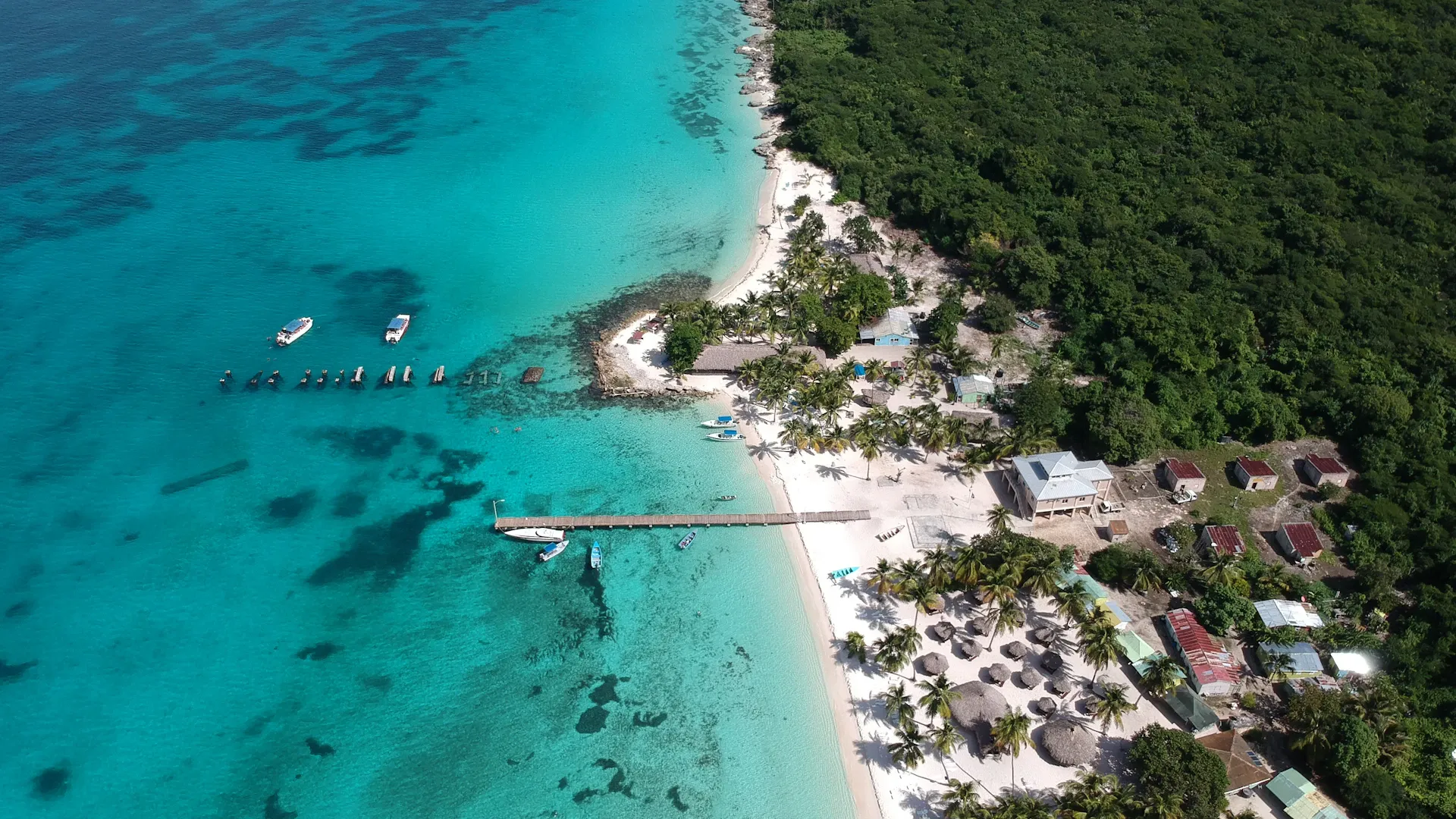
For buyers comparing Punta Cana with Playa del Carmen, the Dominican Republic offers a relatively straightforward ownership structure and potential tax benefits through qualifying tourism developments. Playa del Carmen offers a different proposition: a home in a beach town, with some developments designed to combine personal use and rental income.
Here is how the two opportunities featured in our comparison stack up, and what to confirm before committing your budget.
What the purchase price covers
The Punta Cana development featured in our video is a planned resort community with furnished apartments, professional hotel management, and access to nearby beach and golf amenities. Its proposed features include Mediterranean-inspired architecture and an 850-metre pool. Phase one was quoted for delivery in December 2028.
The quoted starting prices were approximately $172,000 for a one-bedroom apartment and $364,000 for a two-bedroom. That puts a $300,000 buyer within the one-bedroom range. A two-bedroom at the quoted starting price would require a larger budget.
The Playa del Carmen development was presented as a furnished condo hotel with 116 residences, pools, a sky bar, a spa, and a gym. Its quoted entry price of approximately $289,900 sits close to the $300,000 mark.
That leaves about $10,100 before closing expenses and any additional purchase requirements. If $300,000 is your total available cash, rather than your property-price ceiling, request a complete closing estimate before choosing a unit.
| Comparison | Punta Cana development | Playa del Carmen development |
|---|---|---|
| Quoted entry price | One-bedroom from about $172,000 | Entry configuration from about $289,900 |
| Fit for a $300,000 purchase budget | One-bedroom options | Near the starting price |
| Main lifestyle appeal | A managed resort community | A location near the beach and town amenities |
| Rental feature to examine | Hotel rental pool | Lock-off layouts in applicable units |
These are the prices and project details quoted in the video, subject to current availability and confirmation in the purchase documents.
How ownership differs
Foreign buyers can generally hold title directly in their own names in the Dominican Republic. A bank trust is not ordinarily required simply because the buyer is foreign. Local title checks and registration requirements still apply. Guzmán Ariza explains the ownership framework.
Mexico has a different structure for foreign residential buyers in its restricted zone, which extends 50 kilometres from the coast and 100 kilometres from international borders. A fideicomiso allows a Mexican bank to hold title for the foreign beneficiary under an authorized trust. The permit can cover a term of up to 50 years. Mexico’s Ministry of Foreign Affairs sets out these rules.
For a coastal purchase, review the trust’s use, rental, sale, and succession provisions with your own lawyer. Obtain the bank’s actual setup and annual fees so they appear in your ownership budget.
Where CONFOTUR can make a difference
The Dominican Republic’s tourism incentive framework, commonly called CONFOTUR, can provide tax exemptions for eligible purchases in approved developments. Eligibility depends on the project and transaction, so ask for the approval documents and confirmation of the benefits that apply to your unit. The Ministry of Tourism describes the approval framework.
The normal transfer-tax rate is 3%. If the taxable value is $300,000, an applicable exemption could save $9,000. That is a meaningful reduction in the upfront cost. DGII’s transfer guide states the rate.
Annual property-tax savings need a separate calculation. For individuals, the usual 1% IPI charge applies above an annually adjusted exemption threshold, considering the property holdings registered in their name. It is not automatically 1% of a property’s purchase price. A $300,000 apartment therefore does not automatically produce $3,000 in annual tax savings. DGII explains the IPI calculation.
Ask your adviser to calculate the exemption’s value and duration for your situation, then compare it with the full tax and closing-cost estimate for the Mexican property.
Compare the income you actually keep
The Punta Cana proposal described in the video allocates 70% of rental revenue to owners. Before treating that share as income available to spend, establish which costs are deducted before the split and which remain payable afterward. Insurance, reserves, taxes, and owner-specific expenses may require separate allowances.
The Mexican project’s lock-off concept allows applicable apartments to be divided into independently rentable spaces. That can offer useful flexibility for an owner who wants to occupy one part while renting another. Confirm that the specific unit you can afford has that layout and that the management agreement permits your intended use.
A high occupancy rate alone cannot settle the comparison. Ask for a full year of comparable operating results, including room rates, discounts, expenses, and owner distributions. Peak-season occupancy and projected figures should be clearly identified.
For either purchase, calculate annual income after operating expenses against your total acquisition cost. Keep financing and personal income taxes explicit so that both properties are being compared on the same basis.
Choose the property around your priorities
Punta Cana may be the better fit if you want a resort setting, direct ownership, and a purchase that qualifies for useful tax incentives. Playa del Carmen may suit you if you value its town setting and can find a unit whose rental flexibility matches your plans.
Both options require attention to delivery risk, management costs, and resale demand. A price quoted in US dollars also does not eliminate currency exposure in local operating expenses or in converting money from your home currency.
At Dream Second Home (DSH), we connect international buyers with vetted developers. Tell us your budget and which market interests you, and we can introduce you to a developer whose offering fits your plans.
Cover photo by Rodrigo Castro on Unsplash.


