
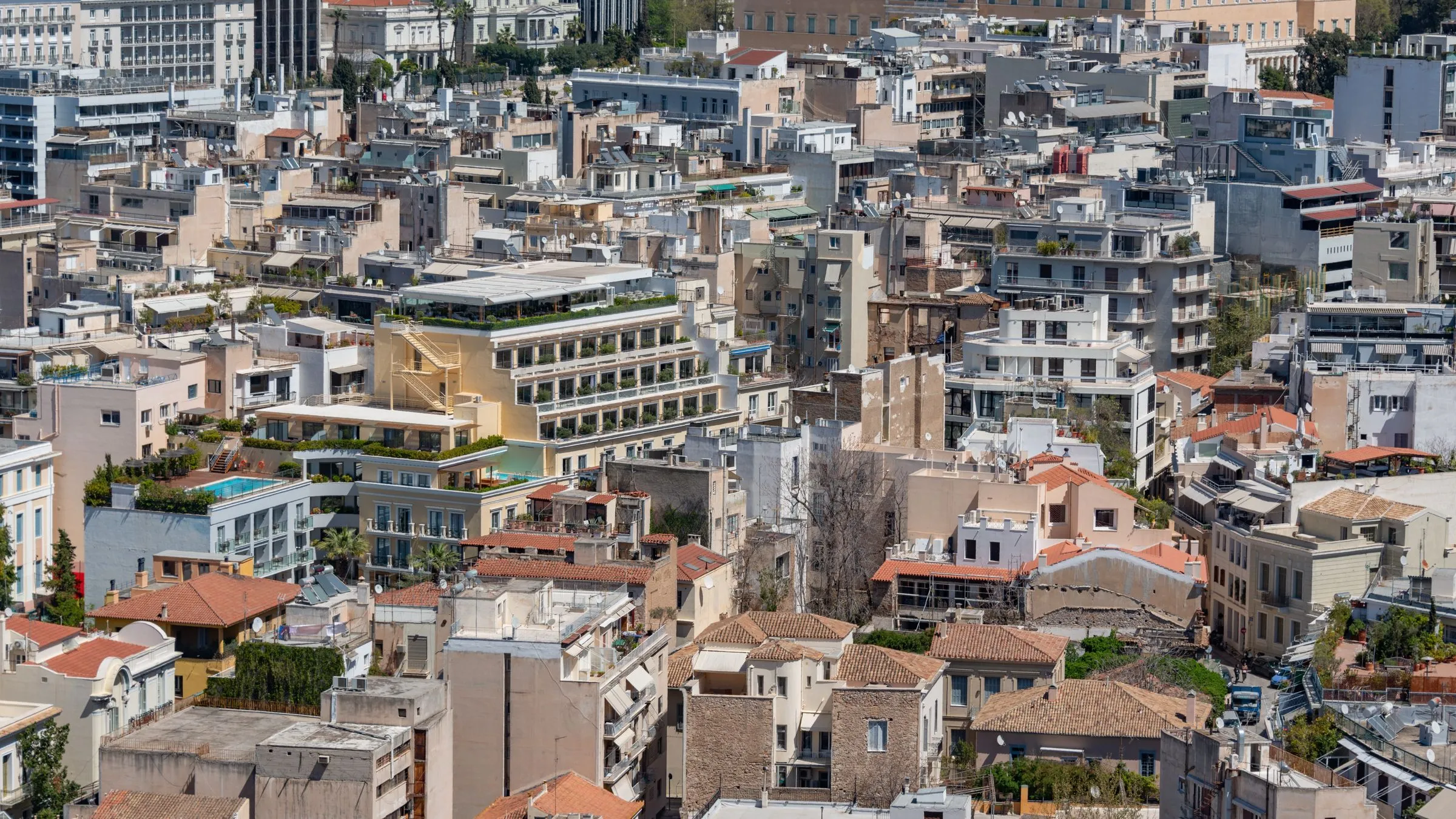
The national figures only tell part of the story. Asking prices within Athens vary more than threefold between neighborhoods, and conditions in an island market can be very different from those in Thessaloniki or Piraeus. Anyone considering a purchase needs to look beyond Greece’s headline growth rate and examine the specific location, building, rental rules and likely resale market.
A note on the figures: the Bank of Greece index is based on bank appraisals rather than completed sale prices. It is useful for tracking direction. The city figures below come from property listings and show asking prices, which may be higher than the final amount agreed. Dollar conversions are rounded at about US$1.15 per euro.
What are prices and rents doing?
The latest Bank of Greece figures, covering the year to March 2026, show apartment prices up 5.7% nationally. The increase was 5.2% in Athens and 6.4% in Thessaloniki, with new apartments rising slightly faster than older ones.
Growth has therefore slowed from 9.1% in 2024 and 8.1% in 2025, but it remains positive. The official data describes a market losing speed, not one that has begun to fall.
Rents have risen faster. The central bank’s rent index increased 8.7% over the past year, while the European Commission’s review of Greek housing recorded a 10% increase in 2025. The Commission also found that housing was becoming less affordable for Greek households. Alongside the country’s limited supply, these rent increases suggest that competition for available homes remains strong.
Are foreign buyers still active?
Yes. Greece’s Golden Visa program offers non-EU citizens a residence permit when they meet its investment requirements. In 2024 the government roughly doubled the minimum property threshold in the most popular areas, and applications subsequently fell by half.
Foreign investment in Greek property did not fall with those applications. It reached €511.6 million, about US$590 million, in the first three months of 2026, 43% more than in the same period a year earlier. This suggests that foreign demand extends beyond buyers pursuing residence permits. The Golden Visa requirements and exceptions are covered separately in Greece Golden Visa.
Strong foreign investment should not be mistaken for high liquidity everywhere. The European Commission estimates that fewer than 1 in 200 Greek homes sells in a given year, compared with roughly 1 in 37 across the EU. That is a national turnover figure, not a prediction of how long an individual home will take to sell, but it is a reason to examine resale demand for the exact location and property type before buying.
Will more homes be built?
More homes are being approved, but new supply is unlikely to arrive quickly. Building permits rose again this spring, although permits for 2025 as a whole fell slightly. Greece still issues only about a third as many permits as it did before the financial crisis, and the European Commission projects that the country could be 110,000 homes short by 2035.
A permit is also several steps removed from a completed home. Construction costs rose another 4% this year, adding pressure to projects that may already be difficult to finance or complete.
The condition of existing homes is just as important as the number of new ones. Of Greece’s roughly three million residential buildings, about 1.7 million were built before 1980, while only around 36,000 were built in the last decade. Buyers will therefore encounter a great deal of older stock. An apartment with a low asking price may still be expensive once structural work, renovation and energy upgrades are included, so those costs need to be assessed before an offer is made.
Can you get a Greek mortgage?
Foreign buyers can obtain Greek mortgages, but the recent increase in lending does not necessarily mean that approval has become easier. New mortgage lending doubled over the past year from a low base, and about 30% of that lending came through government-subsidized programs for Greek residents. In the central bank’s survey of lenders, banks reported no change in their lending standards or rejection rates.
The average new variable-rate home loan carried a rate of 3.56% in June. That average mainly reflects loans to Greek residents. A foreign applicant may face different deposit, income and documentation requirements, and the offer will depend on both the borrower and the property. The application process is covered in buying property in Greece.
What do homes actually cost, city by city?
The figures below come from Indomio, one of Greece’s main property portals, and were reported in July 2026. They are asking prices rather than completed sale prices, so they are best used to compare markets and establish a starting point for further research.
| Market (July 2026 asking prices) | Price €/m² | Change in a year | Rent €/m² per month | Change in a year | Yearly rent ÷ price |
|---|---|---|---|---|---|
| Central Athens | €2,810 | +6.6% | €12.48 | +5.9% | 5.3% |
| Piraeus | €2,656 | +4.1% | €10.82 | +4.4% | 4.9% |
| Athens southern suburbs | €4,189 | +3.9% | €14.04 | +1.9% | 4.0% |
| Athens northern suburbs | €3,681 | +5.8% | €12.79 | +2.6% | 4.2% |
| Thessaloniki | €2,655 | +3.2% | €9.81 | +7.1% | 4.4% |
| Chania | €3,641 | +5.3% | €10.94 | +2.2% | 3.6% |
| Heraklion | €2,310 | +11.2% | €10.01 | +11.8% | 5.2% |
| Corfu | €2,966 | +12.5% | €10.08 | +1.4% | 4.1% |
At the listed averages, a 90 m² apartment in central Athens would carry an asking price of about €253,000, or US$291,000, with an asking rent of roughly €1,120 a month. A 90 m² apartment in Heraklion, Crete’s capital, would carry an asking price of about €208,000, or US$239,000.
The final column divides one year of asking rent by the asking purchase price. It offers a rough comparison of rental value, not an estimate of what a landlord would earn. It excludes taxes, vacancies, management costs and the difference between asking and agreed prices.
City averages conceal substantial local differences. Central Athens ranges from €1,746/m² in Patisia to €5,414/m² in Kolonaki, while seafront Vouliagmeni reaches €7,622/m² despite being included within the broader southern-suburbs figure. The condition of the building can widen the real cost difference further.
The table is most useful as a screening tool. Central Athens and Thessaloniki have year-round rental demand, but older buildings can require significant work. Piraeus is less expensive on average, with marked differences between streets and neighborhoods. Chania and Corfu attract second-home and tourism demand, which makes realistic assumptions about seasonality important. Heraklion has a larger year-round economy than Crete’s resort areas, although its 11.2% annual increase in asking prices warrants a closer look at recent comparable sales before making an offer.
Can a buyer keep an existing Airbnb license?
Not necessarily. In parts of Athens and Thessaloniki, the registration attached to a short-term rental is canceled when the property is sold, while new registrations are temporarily frozen.
Short-term rentals in Greece are regulated. Every rental property needs a registration number from the tax authority, and new operating and safety standards took effect in October 2025. More importantly, the government has frozen new registrations in the busiest areas: Athens’ central districts 1, 2 and 3 through 2026, and Thessaloniki’s city center through December.
Consider a flat in central Athens that is operating successfully on Airbnb. If its registration is canceled at completion and the district is not accepting new registrations, the buyer cannot simply continue the same business. Any valuation based on the seller’s short-term-rental income would then be misleading.
The restrictions vary by location and can change. Before including short-term-rental income in a purchase decision, confirm the current position for the exact address and what happens to its registration after a sale.
So is 2026 a good time to buy in Greece?
There is no single answer for the whole country. Prices and rents are still rising, and limited construction is likely to keep supply tight. Yet affordability has worsened, finance remains selective, older properties can carry large renovation costs, and tighter short-term-rental rules have changed the economics in several popular districts.
For a buyer in 2026, the sensible approach is to calculate the full cost of the property, including necessary building work. Confirm the rental rules for the exact address, compare the asking price with the best available evidence of completed sales, and consider who would realistically buy the property when it is time to sell. Those checks are more useful than trying to predict the top or bottom of Greece’s national market.
When you’re ready to look at actual homes, our Greece destination guide covers the regions and developments from builders that have passed our review. Dream Second Home is an education and referral platform. Buyers should appoint their own lawyer, engineer and tax adviser.
Disclaimer
Dream Second Home is not an investment adviser, law firm, or tax advisory, and this article is not investment, legal, or tax advice. It is an educational market report based on the cited official releases as they stood on August 12, 2026. Newer data will supersede these figures, so check the release dates before relying on them, and confirm anything important with your own licensed professionals.


